11/29/09

Spatchcocked turkey and other Thanksgiving firsts

Matt and I've grown up so much. Just two years ago when we spent Thanksgiving on our own, we ordered and picked up our dinner from our local grocery store. The following year, we spent with family. And then, this year, we found ourselves all alone again, only this time there would be no ordering pre-cooked meals. This time we would cook everything ourselves. Starting with the turkey.

The November Martha Stewart Living is what originally got me thinking that we could do it--specifically the step-by-step guide on how to cook spatchcocked turkey. And before you get totally freaked out (there will be many more opportunities for this), as far as I can tell, spatchcocking is basically just butchering the turkey so that it can flatten out and you can cook it in about 70 minutes instead of 4-5 hours.

Martha's version:

Our version (the next three pictures):

1. Cut out the backbone.


2. Look on in disbelief at the backbone you had someone else (Matt) just cut out of this turkey carcass. Marvel at it. Talk about how disconnected we are from the food we eat. Call a few friends and recommend the movie Food, Inc. again.


3. Step out of the room and fail to take pictures of the step where Matt breaks the breastbone. You are sort of freaked out.

4. While Matt puts the flattened bird in the oven, pour a glass of champagne and mix in a little apple cider. Take a time out and then, when you feel ready, psych yourself up for your next first: Caesar salad.

...In my family, my mom always serves up Caesar salad with Thanksgiving dinner. Despite my deep desire to continue to rag on my mom on this blog as she continues to never check it and/or defend herself, I must say that her Caesar salad is fantastic. That being said, when it came time to buy all the ingredients, Mom was nowhere to be found, so I ended up using Tyler Florence's recipe.


The recipe didn't call for Flott anchovies by name, but after spying this packaging, I may be sold for life. Is that fish wearing a chef's cap on his head or is it a button mushroom?!

Flott + raw egg yolks = the same kind of problem I ran into with the carbonara. The dressing tasted good, but how could I really concentrate on that when part of me knew I was eating the above. (Aggh! Why am I so disconnected from the food I eat?? I was so much happier when I ordered Thanksgiving from the grocery store!) OK, I'm kidding. Mostly.

It's sort of embarassing to admit, but here are some more firsts for us: mashed potatoes, gravy, and stuffing. I guess we are adults for real now?


Matt's plate:

The wrap up: everything was amaaaazing. The turkey was cooked to perfection. The mashed potatoes and gravy, in particular, were insane. We did Ina Garten's recipe for both and she does not disappoint. The Caesar was good, too, but maybe a little too citrusy.

I'll leave you with my favorite picture from the whole day: Matt's to-do list next to my champagne/apple cider cocktail with a section of a clementine tossed in.

Happy Thanksgiving! Hope yours was great!

11/23/09

Jodi's Guest Attempt: A Day with Thomas Keller’s BOUCHON Cookbook--seriously, an entire effing day.

Dear Readers:
Welcome to the Guest-attempt-gone-wild zone. Read along as my good pal, Jodi (of Saucy Little Dish fame), takes on Thomas Keller's Bouchon cookbook. Things are about to get super French and super freaky...

Two years ago, my wonderful husband (merely my boyfriend at the time) bought me Thomas Keller’s Bouchon Cookbook for Christmas. It is gorgeous--larger than your average-sized cookbook, hefty, shiny, with amazing photography and inspiring prose detailing Keller’s philosophies of cooking and the history of the casual “bistro” style of French comfort food. I loved it. I paged through, drooling over the potted food, the terrines, the glistening oyster glamour shots, and then…I put it on a shelf. For two years. Because, as beautiful as it was, it was utterly impractical. Sure, that vinaigrette might be a good staple, but beyond his tips and technique hints, these recipes were so detailed, so skill-heavy, so elaborate–for what he claims is such casual food–they were just too much for me.

Now, I think I’m a pretty good cook. I can whip through most Bon Appétit recipes with no problem at all and know my basics pretty well. So for my first guest Appétempt, I figured I’d brave Mr. Keller’s masterpiece. I’d try to recreate the meals of one of America’s greatest. We’d just gone to the original Bouchon in Napa on our honeymoon, and I was feeling inspired. I’d use his damn cheesecloth idea; use every freaking pot in the house and DO IT. And I would invite Matt and Amelia (and our friends Rachel and Jared) over to enjoy the fruits of my labor. One Day, Three recipes: Salmon Rillettes, his Bibb Lettuce Salad, and the big momma…Boeuf Bourguignon. Let’s do this.

8 am: Wake up and immediately go out to finish shopping. I go to 4 different stores looking for Pernod. Give up and buy Sambuca at CVS instead.

(NOTE: lots of this stuff was done concurrently all day, but I’ll divide it up for reading ease and space conservation.)

10 am: I tackle the Rillettes. Now, Rillettes means potted food. Yummy? This is a steamed and smoked salmon pate. The husband, excited to have a new kind of liquor in our cupboard, starts making weird cocktails with the Sambuca and having me taste. Nothing better than hard liquor at 10:30 am.

Marinated the salmon for a bit in Sambuca, salt and pepper, steamed it, mushed it up, and stirred with crème fraiche, cubed smoked salmon, softened shallots, egg yolks, lemon juice and good olive oil. Smooshed it into pots, smoothed out the top, covered in a “lid” of clarified butter, sealed it up and refrigerated. Served this with baguette slices as an appetizer and it was a hit. Smokey, creamy, and frankly, pretty easy. I’d do this one again.

Thomas Keller/ Bouchon's version:

Mine:

11:00am (and beyond): Now here’s where the adventure really began. I refuse to bore you with exact amounts and technical recipe lingo--the recipe in the book is 4 pages long. It’s intense. Basically, you need a shit load of carrots, onions, leeks, mushrooms and shallots because you will cook THREE SEPARATE BATCHES OF THEM.

A fundamental part of Keller’s cooking is keeping textures right and infusing flavor as much as possible. So we start with a bunch of onion, mushroom stems, carrots, leeks, shallots, thyme, bay, peppercorns, parsley and garlic and cook the hell out of them with an entire bottle of Cabernet until it’s reduced to a glaze (45-60 minutes).

Meanwhile, trim and cube the boneless beef short ribs and brown them in a skillet, in batches.
Once the red wine reduction is ready, and all the meat is browned, add in a crap load MORE garlic, leeks, carrots, thyme, bay leaves, and parsley and stir together.

Yes, the first round was just to flavor the wine reduction. THIS round is to flavor the beef. BUT, heaven forbid these veggies get to TOUCH the beef. Oh no, that would contaminate the beef with mushy veggie particles. Keller wants you to, on top of the wine and second round of veg, make a little nest for the beef out of dampened cheesecloth.

I fold the cheesecloth over the beef, and cover the whole shebang with beef stock. I bring it to a simmer, cover and put in a 325 degree oven (which had been preheated to 350, but then immediately turned down when I put the pot in because Thomas told me to.) for a couple hours, or until the meat is very tender.

3:30ish: The meat is soft, the house smells amazing. So we put the meat in another oven safe pot, discard the cheesecloth, and strain the veggies, keeping the stock.
Strain a couple times, and then strain the stock OVER the beef. Then laugh your head off when you read that you should keep the beef and stock refrigerated for 1-3 DAYS. HA. You get 3 hours--if you’re lucky. I chuck all the cooked veggies and herbs into the garbage. They have served their purpose in Keller’s mind. Then I go on a walk with the (now tipsy) husband. (Oh yeah, he’s still testing out drink recipes. The winner is a Via Veneto – brandy, Sambuca, lemon, sugar and an egg white.) I need some fresh air and I’m not even near done.

Back from our walk, we still have another round of veg to tackle. Earlier, I’d trimmed baby carrots (or bought 'em trimmed like I did), cut up fingerling potatoes, trimmed and cleaned mushrooms and cleaned and trimmed pearl onions which, out of full commitment to this project, I peeled MYSELF. (No Ina Garten-style frozen onions here.) Very proud I didn’t cut myself while peeling these little suckers. Never need to do this task again as long as I live.
Simmer those until soft with peppercorns, garlic, bay and salt. Same with the fingerling potatoes. Same with the pearl onions. Sautéed a bunch of button mushrooms til browned and soft, and crisped up a bunch of lardons in the oven.


Put all the cooked veggies aside. These are your actual veggies for eatin!


About a half an hour before you plan on eating, take the beef and stock from the fridge, heat in a warm oven to soften the stock, and then strain it ONE MORE TIME into another ovenproof sauté pan.

FINALLY, combine veggies, meat, stock and add some chopped parsley, stir it all together, put in the oven til it’s all hot, then dish it up.

Meanwhile, we tossed a bunch of Bibb lettuce with chervil, chives, parsley, and the Bouchon house vinaigrette (using canola oil! Weird!) and then promptly decided to ignore Keller’s suggestion that you reassemble the heads of lettuce on the plates before serving. My people are hungry. That is just silly. Still it looked pretty damn good and tasted even better.

Thomas Keller/Bouchon's:

Mine:

Now, the Bourguignon was good. Maybe too dry? Maybe the sauce wasn’t quite rich enough? But it was warm, comforting and you could definitely taste the POUNDS of veggies that had given their souls to flavor my meat. Or not. At this point, I really didn’t care. It was 8 pm. I’d been working on this for 12 hours. I needed to sit.

Though I’d probably never again spend 12 hours making a bowl of veggies and meat, it was a good meal, casual, comfortable, filled with the fun chatter of people I love. My house was transformed into the bistro that Keller spent 20 pounds of book describing, and it was Boeuf-tiful.

Keller's:

Mine:

(NOTE: the book is back on the shelf, where frankly, it will probably stay for a while, though we finished those rillettes this weekend and I might whip up some more…)

11/16/09

Momofuku's Shrimp and Grits

This attempt involved improvisation, persistence, discipline and endurance. Welcome to the culinary athletic super zone!

Momofuku's version (the picture takes up two pages):


Our version:
It all began when my coworker, Janice (thank you, Janice!), let me borrow the Momofuku cookbook. (For those of you unfamiliar: Momofuku refers to the restaurant trio of Momofuku Noodle Bar, Momofuku Ko and Momofuku Ssäm Bar in NYC.) I'd read a few reviews that warned if you keep kosher or are a vegetarian than this book probably isn't for you. Personally though, I think that this book is for anyone who loves food and a major challenge. (This shrimp and grits recipe is definitely one of the most accessible.)

Plus, I found chef/owner David Chang to be rather inspiring in the semi-archetypal insane artist kind of way. At moments, he also vaguely reminded me of bon appétempt's first culinary hero--Kenny Shopsin.
So what about the actual attempt and my becoming this strange chef-thlete in the aforementioned super zone? Well, I think it's because for the first time in bon appétempt history, I took some more-than minor liberties with the recipe.

1. It called for the grits to be cooked in homemade dashi broth, which didn't seem that hard to make, but it did involve finding konbu, which meant heading to our fave westside Japanese market, which despite trying to do on a few different occasions, we just couldn't fit into our schedules this week. But already committed to the shrimp and grits, we decided to use chicken broth instead.

2. We couldn't find usukuchi (a light, golden-colored soy sauce) and had to substitute regular soy sauce. And so, with two ingredierts substituted, it felt like we suddenly had license to wing it.
Ironically, I think it's this freedom that really saved us from a total fail in the end. The recipe instructed cooking 2 cups of grits with 2 cups of dashi and 2 cups of water, BUT the back of the box of grits instructed us to use 8 cups of liquid to 2 cups of grits. We followed Momofuku's directions anyway (trusting that Mr. David Chang knew something we didn't) but the grits weren't just way too thick and grainy, they were un-stirrable. It was like trying to stir oatmeal that had been left at room temperature for a few months. So, we ended up unscientifically adding water and stock until it arrived at a more agreeable consistency. (Very chef-like, right?)
I really loved how specific the instructions in this recipe were. I made the mistake of returning this book a little too soon--if I had it in my hands right now, I would quote exactly how detailed the recipe tells you to cook the shrimp. However, I did manage to write down one quote from David Chang, which I believe basically sums up why it is as specific as it is.

"I know the difference between Momofuku and McDonald's: caring. Caring about every detail... What is the point of cooking at all if you're not gonna do it right?" Then, he goes on to write about flipping out on his staff, accusing them of not caring enough. And well, can't you relate a bit? I mean, can't we apply this to everything we really care about in life and that frustration when others--others who are supposed to care as equally and passionately--don't? p.s. please forgive me for the lack of homemade dashi and usukuchi, Chef Chang. I truly did care about getting everything else right. I swear. Like the shrimp for example.
I'll tell you what I remember from the directions: after cooking the bacon, it says to sort of wipe the pan clean. Put it back on the burner set to high. Then, take a small batch of the raw shrimp, which have been tossed in a bowl of grapeseed oil and salt, place them on the hot pan and with a metal spatula (uh, sorry again--we only had plastic.), press down on the small batch for 40 seconds or until 40 percent of the translucent grey color has turned pinkish white. When that happens, flip them and do it again for another 40 seconds.

I don't know if Chang is doing anything wildly unique here, but I just loved how exact he wanted those shrimp done. Plus, I loved how the grapeseed oil didn't splatter everywhere and left the cooked shrimp with a light char and a very clean, non-oily taste.

Truth be told, when you actually get into it, the recipe is not as challenging as it was intimidating. It's really just assembling several relatively simple components, one right after the other: grits, bacon, shrimp, poached eggs, and chopped scallions.


The dish also reiterates a lesson that I've been steadily learning: never underestimate the power of the  poached egg.

All in all, nothing could be better on a late Sunday morning. Though I wouldn't recommend entertaining with the dish unless you are comfortable with being in the kitchen almost the whole preparation time. There's just not much you can do ahead of time apart from soaking the grits overnight.
RECIPE:
Uh, remember? I returned the book too early. Sorry. You can buy it here.

11/9/09

Project Recipe: Golden Delicious Apple and Cheddar Turnovers with Dried Cranberries

Sooooo, shortly after we started Bon Appétempt, we realized that there was something that already existed that was quite similar called Project Recipe. Maybe you've heard of it? Well if not, it's two bloggers, Chris and Bridget, working their way through Bon Appétit's top 100 dishes. And not only do they do the whole "their version/ our version" thing, but they're also annoyingly commissioned from the mother ship itself (Bon Appétit).

But then we took a closer look and realized that Project Recipe is kinda jenky. I mean, I know it's supposed to be done by amateurs (note: Matt and I are worse than amateurs!), but in the interest of my unusually extreme competitive nature, I thought we might just take a little comparative look together...

Bon Appétit's version:


Bridget's version:


Chris's version:

 our version:

I mean, they didn't even try to balance the two turnovers on top of one another while resting both atop a glass bowl with something creamy in it!

So, I hope you realize by now that I'm (sorta) joking. All of us are just trying to have fun while tackling gourmet recipes, right? Right.

...which brings us to the first step of the making of the turnovers--a mixture of walnuts, dried cranberries and maple syrup:

I wanted to do this recipe not just to have a Project Recipe face off, but also because it sounded like a hearty dessert we could serve up to our dinner guests after a relatively light soup and salad meal. Though, I had some misgivings when Matt was shredding the cheddar cheese and said, "So, this is gonna be the appetizer, right?"

But rest assured, despite the cheddar, this is definitely a dessert.

One that's wrapped up in puff pastry nonetheless.
 
Aerial shot of Matt and his trusted towel-over-the-shoulder cooking technique. (Seriously, this man will not be in the kitchen without one. Not that there's anything wrong with that.)

Oh, and it should be mentioned that our baking sheets were recently ruined and we've yet to replace them so these guys baked on straight parchment paper. I don't know if this made much of a difference, but these turnovers were fairly average. Mine didn't seem to have enough filling, and I think the recipe could have used a little more maple syrup.

p.s. No hard feelings, Project Recipe. You know we're just a little jealous. :)


RECIPE via Bon Appétit

INGREDIERTS

2 medium Golden Delicious apples, peeled, halved, cored, cut into 1/2-inch cubes (about 2 1/2 cups)
1 1/2 cups (loosely packed) coarsely grated extra-sharp cheddar cheese
1/4 cup pure maple syrup
1/4 cup chopped walnuts
1/4 cup sweetened dried cranberries
Pinch of salt
1 17.3-ounce package frozen puff pastry (2 sheets), thawed
1 large egg, beaten with 1 teaspoon water to blend (for glaze)
Sugar

PREPARATION

Toss first 6 ingredients in medium bowl to blend. DO AHEAD Can be made 2 hours ahead. Cover and chill.

Position 1 rack in top third and 1 rack in bottom third of oven; preheat to 400°F. Line 2 large rimmed baking sheets with parchment. Roll out 1 puff pastry sheet on lightly floured surface to 11-inch square. Using 5- to 5 1/2-inch plate or bowl as template, cut out 4 rounds from pastry. Transfer pastry rounds to 1 baking sheet, spacing apart. Repeat with second pastry sheet, placing rounds on second baking sheet. Spoon filling onto half of each pastry round, dividing all of filling among rounds. Brush edges of pastry lightly with some of egg glaze. Fold plain pastry half over filling; press on edges to seal and enclose filling completely, then press tines of fork along pastry edge to create tight seal. Using tip of small sharp knife, cut two 1/2-inch-long slits in top of crust on each turnover. Brush tops with egg glaze, then sprinkle with sugar.

Bake turnovers until crusts are puffed and golden and juices are bubbling through slits in crusts, about 25 minutes. Carefully run metal spatula under turnovers to loosen and transfer to racks to cool slightly. Serve warm or at room temperature.


11/2/09

Gourmet's Potato and Kale Galette

Now that Halloween and our trip to North Carolina is over, we can get back to the business of making Potato and Kale Galettes. Galette means "whore's pasta," though I may be confusing that with pasta puttanesca.

Gourmet's version:


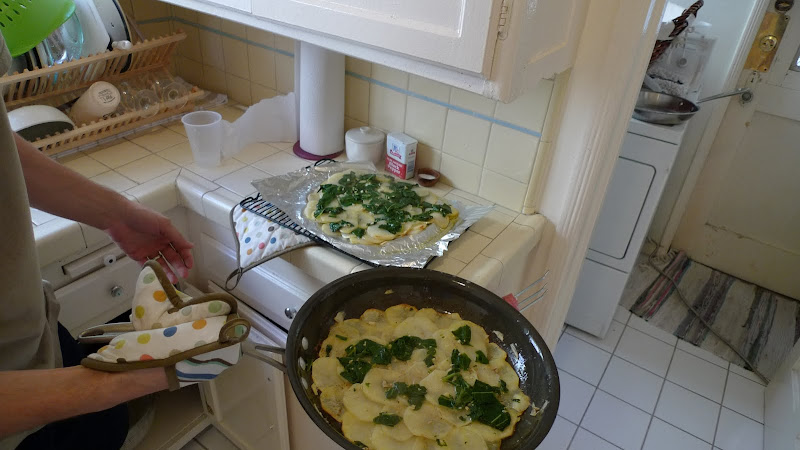
Our version:
I know. And this was our BEST picture.

But look, we had a lot going against us. The first misstep occurred at the market, when Matt picked up collard greens instead of kale.


I don't think this really made a difference. We just boiled them and then sauteed them with butter and garlic.

The second thing we didn't have going for us was our lack of a mandoline. (NOTE: If this blog post were an Amelia Bedelia book, this is where Amelia would pull out a little mandolin guitar.)

Slicing four potatoes 1/16th of an inch thick by hand is no joke. (Check out how afraid I am of slicing my fingers.)


This recipe was not afraid of its butter content. At this point, the pattern sort of became: butter, potatoes, kale, butter, potatoes, kale, butter, butter, butter, repeat.

Next, things got a little meta.

When it came time to flip the potato and kale collard greens galette, things just got sad--the bottom had totally stuck to the pan.

We scraped it off and reassembled and were able to salvage it a little. I mean, it was definitely going to be an aesthetic fail, but we still wanted to eat it (all that butter!). In the end, it looked weird (especially on the one side) but tasted great.

It's good to be back home and bon appetempting.
RECIPE via Best of GOURMET

yield: Makes 8 to 10 servings
active time: 45 min
total time: 1 hr

A crisp potato cake would be tempting enough—even without the surprise of garlicky kale sandwiched between its layers.

Ingredients
1 lb kale, tough stems and center ribs discarded
1 stick (1/2 cup) butter, 6 of the tablespoons melted and cooled
4 garlic cloves, finely chopped
3/4 teaspoon salt
3/4 teaspoon black pepper
2 lb russet (baking) potatoes (4 medium)

Special equipment: a 12-inch heavy nonstick skillet; an adjustable-blade slicer

Preparation

Cook kale in a 4- to 6-quart pot of boiling salted water, uncovered, until just tender, 4 to 6 minutes. Drain in a colander and rinse under cold water to stop cooking. Drain well, squeezing handfuls of kale to extract excess moisture, then coarsely chop.

Heat 2 tablespoons (unmelted) butter in skillet over moderately high heat until foam subsides, then add garlic and cook, stirring occasionally, until golden, about 1 minute. Add kale, 1/4 teaspoon salt, and 1/4 teaspoon pepper and sauté, stirring, until kale is tender, about 4 minutes. Transfer to a bowl and clean skillet.

Peel potatoes and thinly slice crosswise (1/16 inch thick) with slicer. Working quickly to prevent potatoes from discoloring, generously brush bottom of skillet with some of melted butter and cover with one third of potato slices, overlapping slightly. Dab potatoes with some of melted butter.

Spread half of kale over potatoes and sprinkle with 1/8 teaspoon salt and 1/8 teaspoon pepper.

Cover with half of remaining potato slices and dab with butter, then top with remaining kale. Sprinkle with 1/8 teaspoon salt and 1/8 teaspoon pepper. Top with remaining potatoes and sprinkle with remaining 1/4 teaspoon salt and 1/4 teaspoon pepper.

Brush a sheet of foil with melted butter, then brush galette with any remaining butter and place foil, buttered side down, on top. Place a 10-inch heavy skillet on top of foil to weight galette.

Cook galette over moderate heat until underside is golden brown, 12 to 15 minutes. Remove top skillet and foil. Wearing oven mitts, carefully slide galette onto a baking sheet and invert skillet over it. Holding them together, invert galette, browned side up, back into skillet. Cook, uncovered, over moderate heat until underside is golden brown and potatoes are tender, 12 to 15 minutes. Slide onto a serving plate.

Cooks' note: Galette can be made 6 hours ahead and cooled, uncovered, then kept, on a baking sheet covered with foil, at room temperature. Remove foil, then reheat in a 425°F oven until heated through and crisp, about 20 minutes.